


On January 14, the Key Laboratory of Archaeological Sciences and Cultural Heritage Protection of the Chinese Academy of Social Sciences (CASS) held its first major achievement conference of 2026 in Beijing. Zhao Rui, vice president of CASS and a member of the leading Party members’ group at CASS, attended the event and delivered a speech.
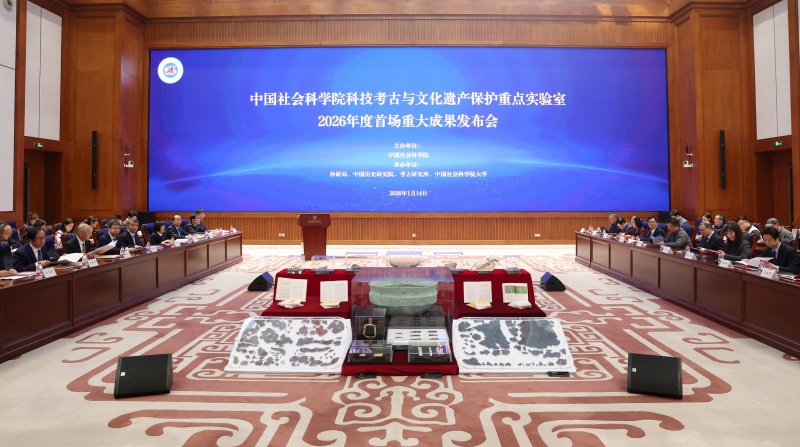
A scene of the conference Photo: Zhu Gaolei/CSSN
Zhao noted that General Secretary Xi Jinping attaches great importance to archaeology and the protection of cultural heritage, and has issued a series of important instructions and directives aimed at clarifying the missions and tasks of archaeological work, while charting the course for the laboratory’s future development. The Key Laboratory of Archaeological Sciences and Cultural Heritage Protection, he said, must uphold Xi Jinping Thought on Socialism with Chinese Characteristics for a New Era as its guiding banner and soul, and consciously shoulder the historical mission of leading technology-empowered archaeological research in the new era. It must resolutely implement the major decisions and arrangements of the CASS leading Party members’ group on strengthening the development of philosophy and social science laboratories, with the goal of achieving both high-quality development and leapfrog advancement.
Zhao emphasized that archaeology,cultural heritage and museology work constitute not only an important cultural undertaking, but also carry the significant mission of demonstrating the nation’s cultural soft power, with far-reaching social and political implications. The systematic application of modern science and technology in archaeological research, he observed, marks a key step in the modernization of traditional archaeology. By breaking down conventional disciplinary boundaries, it has given rise to new research paradigms, provided more precise and effective tools for addressing major archaeological questions, and offered vital support for the high-quality development of archaeology,cultural heritage and museology work in the new era.
The laboratory, Zhao said, should carefully study the construction standards of leading laboratories at home and abroad—especially national key laboratories in the natural sciences—further promoting more scientific, standardized, and well-regulated development. Efforts should be made to take the lead, nationally and internationally, in building a world-class archaeological laboratory. The laboratory should also align closely with the strategic priorities for archaeology in the new era, focusing on fundamental, long-term research topics such as tracing the origins of Chinese civilization and constructing a scientific archaeological narrative of the Chinese nation’s emergence, growth, and development, while carrying out systematic and institutionalized research programs to tackle key problems.
The laboratory should strive to build a high-level platform for interdisciplinary integration, mobilize its strengths to address core questions in civilizational evolution, and deliver a series of landmark achievements that stand at the academic frontier while serving national needs. It should also produce a body of high-quality work combining theoretical depth, academic rigor, and social impact. In addition, efforts should be made to promote the "going global" of Chinese scholarship, presenting the nation's fine traditional culture and rich civilization to the world, so that global audiences may experience China, understand China, and better comprehend China.
Ma Yuan, deputy secretary-general of CASS and executive deputy Party secretary and executive vice president of the Chinese Academy of History (CAH), was also in attendance. Yao Zhizhong, officer-in-charge from the Bureau of Scientific Research Management of CASS, presided over the event. Dong Xinlin, deputy director of the Institute of Archaeology of CASS and director of the Key Laboratory of Archaeological Sciences and Cultural Heritage Protection, announced the list of six major research achievements.
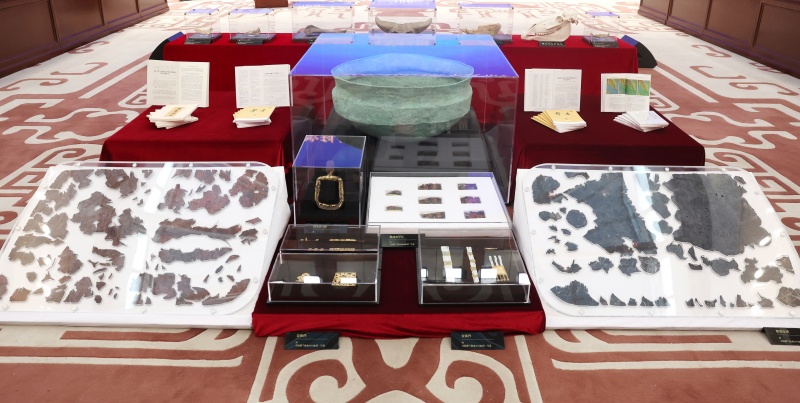
A display of achievements Photo: Zhu Gaolei/CSSN
The six major achievements released at the conference span studies on the origins of Chinese civilization, the protection of Silk Road cultural heritage and interdisciplinary research, as well as the construction of a standardized database of scientific archaeological resources for Chinese civilization.
“Establishing a World-Class Standard Library of Zooarchaeological Resources – Report on the Construction of China’s Animal Resource Specimen Bank” introduces the development of the China Animal Resource Specimen Bank, a sub-library of the Standard Library of Scientific Archaeological Resources for Chinese Civilization. The repository comprises two components: the Ancient Chinese Animal Specimen Bank and the Living Chinese Animal Specimen Bank. In total, it houses more than 100,000 specimens, including ancient animal bone remains excavated from 121 archaeological sites across 26 provinces, as well as living animal specimens of significant research and collection value from across the country. Multidisciplinary collaborative research and interpretation based on these collections provide crucial scientific archaeological evidence for the study of Chinese civilization, help guide the standardized development of infrastructure in the field, and support the national strategy of building China into a cultural powerhouse.
“An Innovative Paradigm for Field Archaeology and Cultural Relic Protection – A Case Study of the Laboratory Conservation Project of the 2018 Xuewei No. 1 Tomb” centers on the 2018 Xuewei No. 1 Tomb and proposes an integrated working model of “precision excavation + emergency protection + restoration research.” This approach enabled the scientific restoration of several sets of precious cultural relics that were severely damaged and structurally complex, including lacquered horse armor components adorned with gold edging—a rare technique in Chinese craftsmanship; a suit of gilded bronze armor—the only extant physical example of a Tang Dynasty golden armor in the country; and a large bronze cauldron characterized by a strong ethnic style. The project offers a replicable and scalable “Chinese solution” for field archaeology and cultural relic conservation.
“Restoration and Research on Tang Dynasty Tie-Dyed Fabrics – New Progress in Experimental Research on Textile Archaeology” focuses on Tang Dynasty tie-dyed fabrics unearthed in Dulan. By applying a dual-evidence approach that combines textual sources with physical artifacts, and by establishing a quantitative evidence chain through interdisciplinary cross-verification, the study confirms China’s historical position as a primary place of origin of tie-dyeing, a world-renowned ancient textile technology of global significance.
“New Archaeological Discoveries in the 10,000-Year History of Agricultural Culture in Northern China – Three Stages of Early Dryland Agriculture in the Regions North and South of the Yanshan Mountains” focuses on key sites related to the origins of dryland agriculture in northern China. Through multidisciplinary collaboration, including radiocarbon dating and carbon-nitrogen stable isotope analysis, the research systematically identifies three critical chronological stages in the development of dryland agriculture and early civilization. Precise radiocarbon dating of key remains from the Sitai site provides empirical evidence for the coexistence of long-term sedentism and the origins of agriculture over a 10,000-year span. Radiocarbon and isotopic analyses of human remains from the Xinglongwa and Xinglonggou sites demonstrate that a dryland agricultural society had already formed between 7,800 and 7,500 years ago. Comprehensive research in the core area of the Hongshan culture further substantiates the mechanism by which agriculture drove the process of civilization.
“Archaeological Discovery of China’s Earliest Ancient Myrica Rubra Tree – A Study of Ancient Bayberry Tree Remains from the Liangzhu Culture Period at the Shibao Site” employs scientific methods including dendrochronology, radiocarbon dating, wood anatomy, and Pyrolysis/Gas Chromatography–Mass Spectrometry (Py/GC-MS). The study identifies ancient tree remains unearthed at the Shibao site in Yuyao, Zhejiang Province, as bayberry trees dating to around 2520 BCE, during the Liangzhu culture period. This marks the first time in China that ancient bayberry remains have been identified at the species level, providing the earliest and most definitive physical evidence of Myrica rubra.
“Digital Archaeology Uncovers China’s Prehistoric Water Conservancy Projects from Around 5,000 Years Ago – A Study of China’s Prehistoric Water Control Civilization” integrates cutting-edge technologies such as satellite remote sensing, UAV aerial photography, 3D site reconstruction, LiDAR scanning, and spatial simulation. By deeply integrating field archaeological findings with regional digital elevation models and related data, the study proposes models of water management for prehistoric settlements around the Liangzhu Ancient City and in the Jianghan Plain, from the perspectives of flood control and irrigation. The research reveals how ancient populations understood climatic and hydrological conditions, managed water resources in a rational and systematic manner to respond to climate change, achieved a balanced relationship between humans and their environment, and fostered the emergence and development of prehistoric civilizations.
The conference was hosted by the CASS and co-organized by the Bureau of Scientific Research Management under CASS, CAH, the Institute of Archaeology of CASS, and the University of Chinese Academy of Social Sciences.