


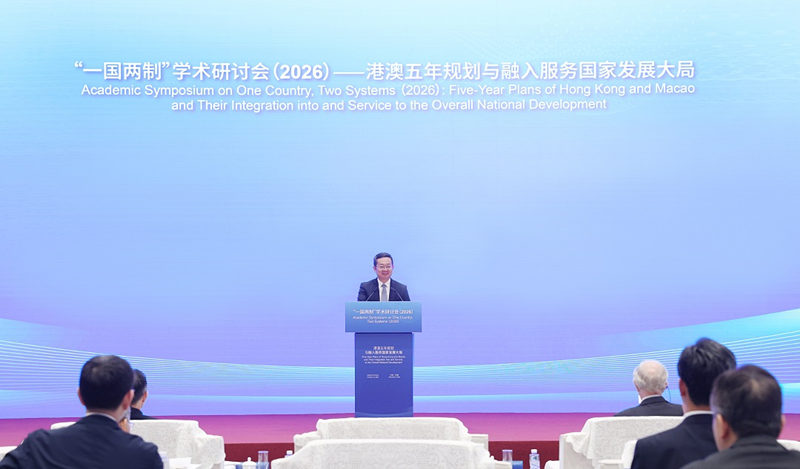
A scene of the symposium Photo: Zhu Gaolei/CSSN
The 2026 Academic Symposium on One Country, Two Systems was held in Shenzhen on Oct. 24, focusing on Hong Kong and Macao’s five-year plans and their integration into and contributions to overall national development. Gao Xiang, president of the Chinese Academy of Social Sciences (CASS); Deng Zhonghua, former deputy director of the Hong Kong and Macao Affairs Office of the State Council and president of the Chinese Association of Hong Kong and Macao Studies; Wong Yuen-shan, head of the Chief Executive’s Policy Unit of the Hong Kong Special Administrative Region (SAR); Cheong Chok-man, director of the Policy Research and Regional Development Bureau of the Macao SAR; Grzegorz Kolodko, former deputy prime minister and minister of finance of Poland and a professor at Kozminski University in Warsaw; and Xu Yangsheng, president of The Chinese University of Hong Kong, Shenzhen, delivered addresses at the opening ceremony. Li Xuesong, vice president of CASS, chaired the session.
Gao noted that, as Hong Kong introduces and implements its first five-year plan and Macao its latest, the symposium seeks to deepen understanding of and put into practice General Secretary of the CPC Central Committee Xi Jinping’s key statements on Hong Kong and Macao affairs. The symposium also aims to draw on academic expertise to advance the implementation of “One Country, Two Systems.”
The formulation and implementation of five-year plans by Hong Kong and Macao, Gao continued, have brought about institutional alignment between the respective strengths of the “Two Systems” within the framework of “One Country.” They reflect Hong Kong and Macao’s commitment to “One Country” as the foundation and their efforts to align with the national governance system, while pioneering a new governance model that combines a well-functioning government with an efficient market.
Gao added that an important mission for scholars in philosophy and the social sciences is to accelerate the development of China’s independent knowledge system centered on theories and practices within the “One Country, Two Systems” framework. CASS is ready to deepen cooperation with the Hong Kong and Macao SAR governments and counterparts from relevant research institutions.
Guest speakers and experts held in-depth discussions on how five-year plans can enhance the two SARs’ core competitiveness, how their unique advantages can contribute to China’s high-standard opening up, and how development of the Guangdong–Hong Kong–Macao Greater Bay Area can support their integration into overall national development. Examining the plans from the perspectives of history, governance, and development, participants described their adoption as a milestone in the implementation of “One Country, Two Systems.”
Hosted by CASS and organized by its Center for Hong Kong and Macao Studies, the event brought together nearly 100 guests and scholars from the Chinese mainland, Hong Kong, Macao, and overseas.