


SHANGHAI—The Sixth National High-Level History Forum and the 18th Historical Research Frontier Forum opened in Shanghai on Dec. 17 under the theme “Developing a System of Defining Symbols of Chinese Culture.” Gao Xiang, president of the Chinese Academy of Social Sciences (CASS) and secretary of its leading Party members’ group, as well as director general and Party secretary of the Chinese Academy of History (CAH) under CASS, attended the opening ceremony and delivered remarks.

Gao Xiang, president of the Chinese Academy of Social Sciences (CASS) and secretary of its leading Party members’ group, as well as director general and Party secretary of the Chinese Academy of History (CAH) under CASS, delivered remarks. Photo: Zhu Gaolei/CSSN
In his speech, Gao noted that the CPC is a political party distinguished by its historical vision, its emphasis on historical thinking, and its ability to draw lessons from history. In 1954, the CPC Central Committee decided to establish the national-level history journal Historical Research, with Comrade Mao Zedong personally determining its guiding principle of “letting a hundred schools of thought contend.” Since the 18th CPC National Congress, General Secretary Xi Jinping has attached great importance to historical studies, repeatedly stressing the need to respect, study, and research history. He personally planned and promoted the establishment of the CAH, charting a clear course for the flourishing of Chinese historical studies in the new era.
Gao underscored the need to thoroughly study and implement General Secretary Xi Jinping’s important expositions on historical science and, at the intersection of both history and the present, open up new horizons for the prosperity and development of historical studies in the new era by carrying forward the fine traditions of historical scholarship.
Gao further called on historians in the new era to follow the proper path of studying social formations, deepen their understanding of the underlying laws governing major historical issues, and advance the development of an independent knowledge system for Chinese historical studies by producing intellectually engaging scholarship. He urged them to carry on the academic tradition of applying history to contemporary governance, enrich and expand historical understanding through engagement with major real-world issues, and offer systematic, forward-looking, and creative scholarly insights to support Chinese modernization, pursuing scholarship that is compassionate and humanistic. He also stressed the importance of upholding traditions of seeking truth and evidence, adhering to scientific principles and norms, and defending truth with integrity. At the same time, efforts are likewise needed to promote a diversity of perspectives and encourage academic debate, to foster academic dialogue and exchanges, and to master and effectively utilize cutting-edge technologies such as artificial intelligence so as to remain at the forefront of academic progress and contribute research that helps shape the future.
Gao pledged that the CAH stands ready to work with its counterparts nationwide to jointly shoulder the sacred mission of leveraging history to illuminate the present and inform governance and education, to collectively plan the future of Chinese historical studies in the new era, and to contribute greater historical insight and intellectual strength to the building of a strong country in all respects and national rejuvenation through Chinese modernization.
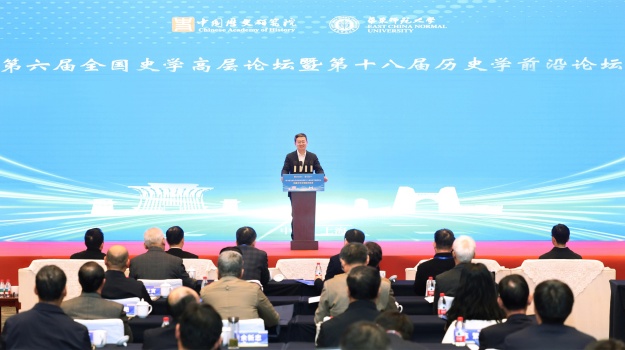
A scene of the conference Photo: Zhu Gaolei/CSSN
Li Jun, secretary of the CPC Chongming District Committee of Shanghai, remarked that Shanghai is a city with a long history, rich cultural heritage, and a proud revolutionary tradition. Both an important representative of Jiangnan culture and the birthplace of the CPC, the city has developed distinctive urban functions that make it a key symbol of the modern transformation and innovative development of Chinese civilization. He expressed the hope that experts and scholars would offer valuable suggestions on further exploring historical and cultural resources and strengthening the preservation of history and culture, thereby bolstering the creative transformation and innovative development of China’s fine traditional culture.
Mei Bing, Party secretary of East China Normal University (ECNU), said that the conference represented a concrete effort by the historical community to explore pathways for the transmission and development of Chinese civilization and to advance the construction of an independent knowledge system for Chinese historical studies. She extended hope that participating scholars would engage in broad exchanges and in-depth discussions, interpreting the spiritual essence of Chinese civilization from deep within history, and examining contemporary expressions of civilizational symbols from a contemporary perspective, allowing the spiritual symbols of Chinese civilization to take on renewed vitality in the new era.
Ma Yuan, deputy secretary-general of CASS and executive deputy Party secretary and executive vice president of the CAH, presided over the opening ceremony. Yang Yanqiu, a member of the Standing Committee of the CAH Party Committee and vice director general of the CAH, as well as Party secretary and director of the CAH’s Institute of Ancient History, chaired the keynote report session. Liu Zuokui, a member of the Standing Committee of the CAH Party Committee and Party secretary and director of the Institute of World History at the CAH; Qu Jun, Party secretary of the Department of History at ECNU; Wang Xin, director of the Institute for Western Frontier Region of China at Shaanxi Normal University; and Zhao Xiaolong, an assistant research fellow at the CAH’s Institute of Ancient History, delivered keynote reports.
Experts and scholars from multiple domestic research institutions and universities, along with representatives from the CAH’s journal matrix, attended the conference. Participants discussed the development of a system of defining symbols of Chinese culture by drawing on perspectives from ancient Chinese history, modern history, and world history. They noted that Chinese civilization is profound and enduring, and that over the course of its long historical evolution, it has crystallized a rich array of civilizational symbols. These symbols serve as important emblems and carriers of Chinese culture, embodying the cultural memory and emotional identity of the Chinese nation, and play a vital role in strengthening national pride and cohesion. The Recommendations of the CPC Central Committee for Formulating the 15th Five-Year Plan for National Economic and Social Development, adopted at the Fourth Plenary Session of the 20th CPC Central Committee, explicitly calls for “developing a system of defining symbols of Chinese culture,” identifying it as a key measure and objective for promoting cultural development. Historians, attendees agreed, should strengthen systematic research and theoretical interpretation of these symbols, further distill the core elements of Chinese civilization, and integrate them across fields, disciplines, and levels, thereby making meaningful contributions to the development of such a system.
The two-day event was co-hosted by the CAH and ECNU, and organized by the Historical Research Press under the CAH, the Department of History at ECNU, and the CAH’s special work office.