


On Jan. 30, a dialogue on civilizational exchanges and mutual learning between China and Uzbekistan was held in the ancient city of Samarkand, Uzbekistan. Gao Xiang, president of the Chinese Academy of Social Sciences (CASS), Aziz Boboev, governor of Samarkand Region, and Tursunali Kuziyev, first deputy director of the Agency of Cultural Heritage of Uzbekistan and former minister of Culture and Sports, delivered remarks at the event. The opening session was chaired by Li Guoqiang, a CASS Member and deputy director general of the Chinese Academy of History (CAH) under CASS.
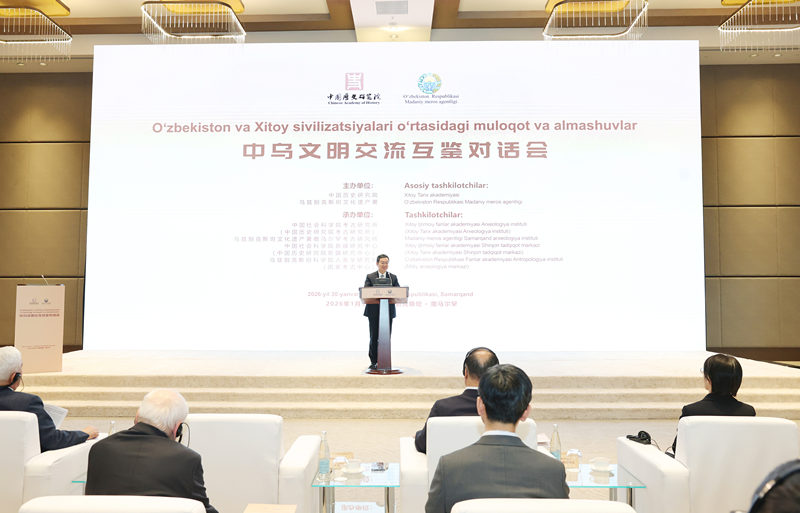
A scene of the dialogue Photo: Zhu Gaolei/CSSN
Gao stated that the Fourth Plenary Session of the 20th CPC Central Committee, held in October 2025, explicitly emphasized the importance of “promoting the building of a community with a shared future for humanity, engaging in deeper exchanges and mutual learning with other cultures, and pursuing high-quality Belt and Road cooperation.” The convening of this dialogue represents a concrete action to implement the spirit of the fourth CPC plenum and a vivid practice of deepening people-to-people cooperation and exchanges between China and Uzbekistan.
Over the 34 years since the establishment of diplomatic relations, Gao continued, China and Uzbekistan have kept pace with the trends of the times and forged a new path of good-neighborly friendship and win-win cooperation. Relations between China and Central Asian countries have achieved a historic leap, evolving from good-neighborly friendship to strategic partnership and further to a community with a shared future.
In his keynote speech at the second China-Central Asia Summit in June 2025, President Xi Jinping proposed a China-Central Asia Spirit of “mutual respect, mutual trust, mutual benefit, and mutual assistance for the joint pursuit of modernization through high-quality development.” Gao noted that, to chart a new future for the China-Uzbekistan all-weather comprehensive strategic partnership in the new era and to pursue all-around cooperation aligned with the vision of wellbeing for the peoples of both countries, it is essential to continuously deepen civilizational exchange and mutual learning between the two nations.
Gao put forward three suggestions for deepening China-Uzbekistan civilizational exchange and mutual learning. First, he called for strengthening people-to-people exchanges and cooperation to consolidate the foundation of bilateral exchange and mutual learning. In this regard, the two countries share a profound historical foundation, broad scope, and great potential. In the new era and on the new journey, it is vital to innovate forms of cooperation, enrich the substance of collaboration, and build cooperative platforms, advancing practical and effective cooperation in areas such as joint archaeological work, research on the history and heritage of the Silk Road, cultural heritage protection and restoration, museum exchanges, and the repatriation of lost cultural relics.
Second, Gao recommended innovating cooperation mechanisms to broaden the practical pathways for China-Uzbekistan civilizational exchange and mutual learning. He noted that interdisciplinary integration is needed to more comprehensively reveal the ideas and concepts embedded in historical and cultural heritage. Through joint project research and diverse forms of academic exchange, the historical origins, contemporary value, and global significance of bilateral civilizational exchange can be elucidated in a more systematic manner. Scholarly interaction and joint talent cultivation, he added, are crucial for providing a rich source of strength for the preservation of civilizations, cultural innovation, and theoretical creation in both countries.
Third, Gao urged efforts to shoulder the mission of the times to propel China-Uzbekistan civilizational exchange and mutual learning to new heights. He stressed that CASS stands ready to engage in in-depth, specialized, and institutionalized cooperation with research institutions and universities in Uzbekistan, jointly organizing academic seminars, youth forums, summer camps, and other activities to advance interdisciplinary research and explore new forms of China-Uzbekistan people-to-people exchanges.
Boboev stated that Samarkand Region and China share a long-standing and profound historical connection. Since the era of the ancient Silk Road, economic, trade, and cultural exchanges between the two sides have continued to deepen. At present, within the framework of the Belt and Road Initiative (BRI), this cooperative relationship has entered a new stage of development and has made significant contributions to regional synergy.
The high level of mutual trust, deep friendship, and close interaction between the leaders of Uzbekistan and China have injected new momentum into the development of bilateral relations, inspiring both sides to more fully unleash their respective development potential, Boboev remarked. He added that the dialogue serves as an important practical platform for ensuring and promoting long-term cooperation between the two countries in the fields of science, education, and culture.
Archaeological cooperation between China and Uzbekistan began in 2011, when the Samarkand Institute of Archaeology signed a cooperation agreement with the Institute of Archaeology at CASS, laying a solid foundation for subsequent international joint projects and archaeological expeditions. Boboev expressed his sincere hope that the dialogue would further strengthen friendship and cooperation between the two countries in this domain.
Kuziyev emphasized that hosting this event in Samarkand carries profound significance. To understand Uzbekistan and its history, one must first understand Samarkand. As early as over 2,000 years ago, the Chinese diplomat Zhang Qian had arrived here. The China-Uzbekistan joint archaeological achievements displayed outside the venue bear witness to these historical interactions. While acknowledging existing achievements, Kuziyev underscored the need to further deepen cooperation, adding that China has made many advancements in high-tech methods for cultural heritage protection and restoration worthy of study and reference. He noted that more young people will be sent to China for exchanges, enabling them to understand how China perceives Uzbekistani history while sharing insights into the histories of both countries and of human civilization as a whole.During the dialogue, scholars from China and Uzbekistan engaged in in-depth discussions on two themes: “Historical experiences of the Silk Road and mutual learning among civilizations” and “China-Uzbekistan archaeological cooperation and cultural heritage preservation.”
“China-Uzbekistan archaeological collaboration has demonstrated the significance and prospects of such cooperation. The empirical archaeological data obtained through this partnership reveal that the vitality, competitiveness, maturity, and efficiency of ancient societies can serve as foundational templates for today’s world,” articulated Shi Jinsong, deputy director general of the Institute of Archaeology at CASS. “In ancient times, the diversity, scope, and intensity of communication and exchange between different regions exceeded modern imagination. Along the ancient Silk Road, not only were goods exchanged, but knowledge and values were also shared.”
Liu Zifan, a research fellow from the Institute of Historical Theory at CASS, stated: “Delving into history, we can find that the ancient Silk Road, which connected China and Central Asia, was never merely a trade route but also a thoroughfare for inter-civilizational exchange and mutual learning. It linked civilizations across Eurasia, representing a path of openness, peace, and inclusiveness. The BRI in the new era is deeply rooted in historical and cultural heritage, embodying the spirit of the ancient Silk Road revitalized in contemporary times.”
The dialogue was jointly organized by the CAH and the Agency of Cultural Heritage of Uzbekistan. Witnessed by Gao and Kuziyev, Shi Jinsong and Muminjan Sayidov, director of the Samarkand Institute of Archaeology under the Uzbekistani Agency of Cultural Heritage, signed a memorandum of understanding between the CASS Institute of Archaeology and the Samarkand Institute of Archaeology. The agreement aims to enhance cooperation between the two archaeological institutions in the fields of archaeology and anthropology.