


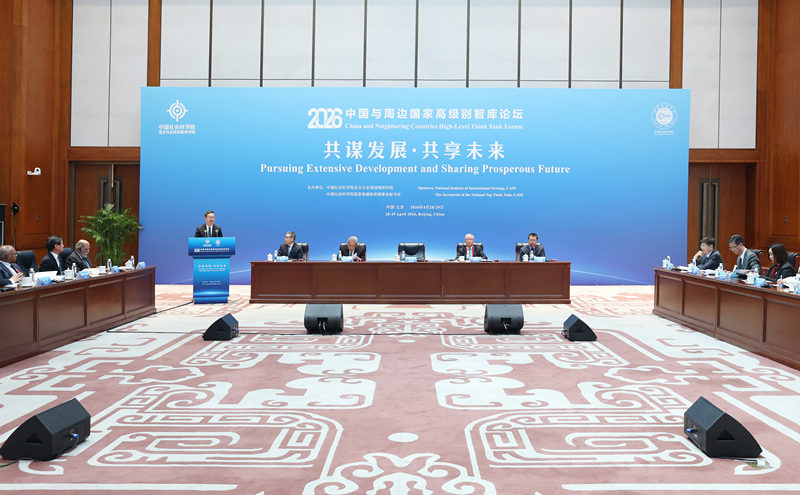
A scene of the forum Photo: Zhu Gaolei/CSSN
On April 28, the 2026 China and Neighboring Countries High-Level Think Tank Forum was held in Beijing under the theme “Pursuing Extensive Development and Sharing Prosperous Future.” Gao Xiang, president of the Chinese Academy of Social Sciences (CASS), Phinij Jarusombat, former deputy prime minister of Thailand, and Hyun Oh-Seok, former deputy prime minister of South Korea, attended and addressed the opening ceremony.
Gao noted that today, our world, our times, and history are changing in ways like never before. The historical trends of peace, development, cooperation, and mutual benefit are unstoppable. The will of the people and the general trends of our day will eventually lead to a bright future for humanity. And yet, the hegemonic, high-handed, and bullying acts of using strength to intimidate the weak, taking from others by force and subterfuge, and playing zero-sum games are exerting grave harm. The deficit in peace, development, security, and governance is growing. All of this is posing unprecedented challenges for human society. In this context, Gao said, China remains firmly committed to building a community with a shared future with neighboring countries and working with them to achieve common development. The Central Conference on Work Related to Neighboring Countries, held in April 2025, outlined the approach and measures for jointly creating a better future with neighboring countries, injecting predictable and sustainable positive energy into a world marked by change and turbulence.
Gao emphasized that the future one can reach is defined by the depth of one’s historical perspective. Millennia of exchanges among civilizations have repeatedly shown that only by treating neighbors with goodwill and as partners can countries lay a solid foundation for harmonious coexistence. Looking ahead, he called for deepening mutual trust through “good-neighborliness,” strengthening guarantees for “security among neighbors,” and advancing cooperation for “prosperity among neighbors.” With a more open mind and more pragmatic actions, Gao said, China stands ready to work with neighboring countries to forge a new type of international relations characterized by a shared future and win-win cooperation.
Noting that the forum coincided with the first anniversary of the Central Conference on Work Related to Neighboring Countries, Gao expressed the hope that participating experts and scholars would draw on their professional expertise, actively offer advice and suggestions, and contribute more insight and strength to building a community with a shared future with neighboring countries in the new era.
Jarusombat stated that China and Thailand share a bond akin to family, and that genuine, truly enduring economic and political cooperation between the two countries must be built on trust. Chinese modernization, he said, is not only a blueprint for China’s own development, but also offers valuable experience and opportunities for countries in the Global South. He called on Asian nations to uphold multilateralism and work together to build an Asian community rooted in traditional wisdom and driven by modern innovation.
Hyun remarked that the global economy has entered a new phase shaped by geopolitical shocks, in which economic policy is increasingly influenced by strategic considerations and globalization is being reconfigured along more strategic lines. He suggested that countries draw on the Chinese concept of “Tongzhou Gongji,” meaning “crossing the river in the same boat,” to jointly stabilize economic relations, reduce uncertainty, maintain an open and predictable economic system, and build a more resilient and inclusive global economy.
Following the opening ceremony, keynote speeches were delivered by Li Xiangyang, a CASS Member; Sujan R. Chinoy, director general of the Manohar Parrikar Institute for Defence Studies and Analyses in New Delhi, India; Feng Weijiang, secretary general of the Council of National High-End Think Tanks at CASS; A. S. M. Ridwanur Rahman, director general of the Bangladesh Institute of International and Strategic Studies; and Huang Ping, director of the Chinese Institute of Hong Kong under CASS.
Think tank representatives from neighboring countries, along with experts and scholars from Chinese research institutions, think tanks, and universities, participated in the forum. They held in-depth discussions on strategic cooperation, economic development, and people-to-people exchanges between China and its neighboring countries.
Attending scholars concurred that China and its neighboring countries are linked by mountains and rivers, connected by cultural affinities, and bound by intertwined destinies. In the face of practical challenges posed by certain countries’ pursuit of unilateralism and bloc confrontation, they said, neighboring countries should carry forward the tradition of good-neighborly friendship, uphold the principles of amity, sincerity, mutual benefit, and inclusiveness, and promote positive interaction between security and development. Participants also said they would take the forum as an opportunity to fully leverage the bridging role of think tanks, conduct in-depth research and offer policy suggestions on key areas and major issues in cooperation between China and its neighbors, and make due contributions to building a community with a shared future with neighboring countries.
The forum was co-organized by the National Institute of International Strategy at CASS and the Secretariat of the Council of National High-End Think Tanks.