


ATHENS—On June 8, the Young Scholars’ Roundtable, themed “Continuity of Past and Present: Youth Perspective on Classical Studies and Philosophy & Social Sciences” was held at the Chinese School of Classical Studies at Athens (CSCSA) in Athens, Greece, as a sub-event of the Second World Conference of Classics. Gao Xiang, president of the Chinese Academy of Social Sciences (CASS), attended the meeting and delivered an address.
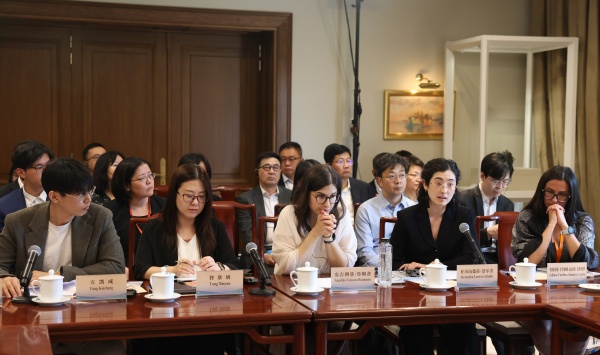
A scene of the roundtable Photo: Zhu Gaolei/CSSN
The roundtable noted that classical studies is both a field within the humanities, philosophy, and social sciences, and a bridge for deepening exchange and mutual learning among civilizations. Classical civilizations, radiant as stars across history, were separated by vast distances yet converged on many core concerns, sharing kindred intellectual and spiritual pursuits across millennia. Their vitality has endured through the ages.
Today, our world, our times, and history are changing in ways like never before. Humanity urgently needs to draw wisdom from classical civilizations and nourishment from global civilizational exchange, so as to jointly address shared challenges and advance human progress.
The CSCSA is the first high-level, national, specialized research institution established overseas by CASS. It will support Chinese and international scholars in conducting research on Chinese and other classical civilizations, while promoting the inheritance and development of civilizations as well as exchanges and mutual learning among them.
The meeting emphasized that young scholars represent the future of classical studies—they are inheritors of classical wisdom, promoters of inter-civilizational exchange and mutual learning, and pioneers in guiding contemporary development. To help them fulfill these roles, efforts should be made to build a high-level platform for Chinese and international young scholars to engage in civilizational dialogue and interdisciplinary collaboration, enabling classical studies to deepen and expand from a global perspective.
Young scholars were encouraged to uphold fundamental principles while breaking new ground, and to closely align their academic research with the pulse of the times. They should follow a path of inclusive mutual learning, grasping the essence of classical traditions while bringing them to bear on contemporary concerns, and embracing interdisciplinary integration, so as to provide sound answers to the questions posed by the world and the times.
Participating young scholars noted that classical studies is an academic field of profound intellectual value. Classical resources from different civilizational traditions not only offer pathways to understanding history, but also provide insights for responding to contemporary political, ethical, ecological, and other issues. Whether through reinterpretations of the deep humanistic concern embodied in Chinese classics, or renewed examinations of the relationship between ancient Greek natural philosophy and ecological ethics, classical studies is reshaping its own problem consciousness within a broader global horizon. Scholars affirmed the need to engage in equal dialogue on the basis of a deep understanding of their respective civilizational traditions, allowing classical wisdom to continually generate new intellectual vitality in the contemporary world.
The meeting was organized by the CSCSA. Young scholars of classical studies from China, Greece, the United States, Colombia, and other countries and regions exchanged views on the contemporary significance and future development of classical studies.