


ATHENS—On June 11 local time, Gao Xiang, president of the Chinese Academy of Social Sciences (CASS), led a delegation in Athens to meet with Dora Bakoyannis, Chair of the Standing Committee on National Defence and Foreign Affairs of the Hellenic Parliament, and her delegation. The two sides held in-depth discussions on deepening China–Greece people-to-people and cultural exchanges and promoting mutual learning among civilizations.
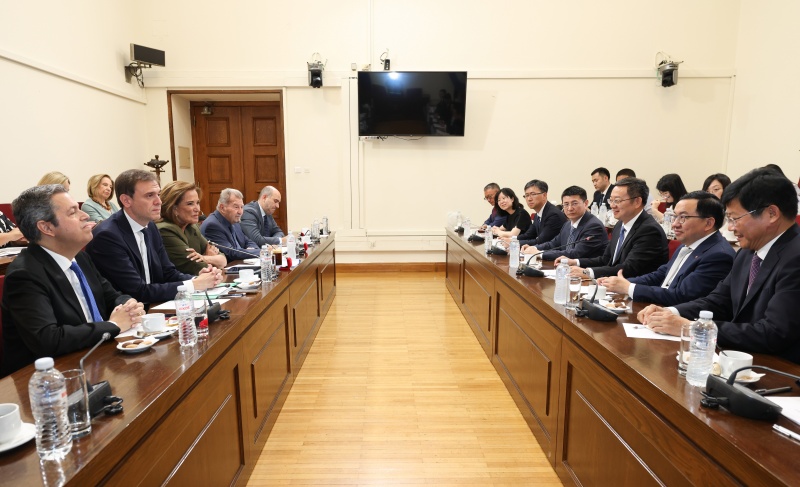
Gao Xiang meets with Dora Bakoyannis and her delegation. Photo: Wang Zhou /CSSN
Gao noted that this year marks the 20th anniversary of the establishment of the comprehensive strategic partnership between the People’s Republic of China and the Hellenic Republic. Over the past two decades, the two countries have remained good friends, demonstrated mutual respect and trust, and maintained effective partners, pursuing mutual benefit and win-win cooperation. Civilizational and academic exchanges between China and Greece constitute dialogues of global significance—between civilizations and among scholars. Recently, the two countries successfully co-hosted the Second World Conference of Classics, drawing widespread attention from the international classical studies community and the broader humanities and social sciences fields.
As a key initiative to implement Chinese President Xi Jinping’s Global Civilization Initiative and the important consensus reached by the leaders of the two countries, the Chinese School of Classical Studies at Athens (CSCSA) was officially established in November 2024, becoming China’s first overseas academic institution dedicated to the study of classical civilizations. Since its founding, CSCSA has steadily advanced its work, and the Angelokastro Archaeological Project has been officially launched. These achievements have laid a solid foundation for further deepening civilizational exchanges and mutual learning, as well as academic cooperation between China and Greece.
Gao stated that CASS is willing to work with all sectors in Greece, using the World Conference of Classics and CSCSA as important platforms, to further promote exchanges and cooperation between the intellectual communities of the two countries and advance people-to-people and cultural exchanges in greater depth and substance. He called for deeper academic research cooperation through joint studies and academic exchanges on major issues of shared interest, including the origins of civilizations, civilizational development, and paths to modernization. He also emphasized the need to strengthen exchanges and mutual visits among young scholars from the two countries, and to create more opportunities for them to engage in research, academic exchange, and archaeological practice through platforms such as the the CSCSA Global Visiting Scholar Program. In addition, he called for stronger collaboration in archaeological excavation, research, and public communication, as well as deeper cooperation in archaeological science, cultural relic conservation and restoration, and museum development, so as to jointly advance the study of ancient civilizations and produce more research outcomes.
Bakoyannis spoke highly of CASS’s achievements in fields such as cultural relic conservation and restoration and archaeological science, and emphasized the important role of the Second World Conference of Classics and CSCSA in promoting civilizational exchanges and mutual learning between Greece and China. She noted that Greece and China share similarities and common ground across various fields, and that ancient thinkers developed intellectual resources that can serve as sources of mutual inspiration in areas such as state governance and civilizational development. At a time when the world faces new challenges arising from the rapid development of artificial intelligence, science, and technology, the significance of classical studies lies not only in looking back to the past, but also in providing intellectual resources and historical reference for understanding the present and looking toward the future.
During the visit, Gao and his delegation also traveled to Crete to inspect CSCSA’s planned archaeological excavation projects. There, they met with Stavros Arnaoutakis, Governor of the Region of Crete; Vassiliki Sythiakaki, director of the Ephorate of Antiquities of Heraklion; and Stella Chryssoulaki, general director of the Heraklion Archaeological Museum. Through these exchanges, the delegation gained a detailed understanding of the latest academic progress in research on Minoan civilization and held in-depth discussions with Greek experts on issues including the origins and development of Minoan civilization, the restoration of frescoes at the Palace of Knossos, research on the Linear B script, exchanges among ancient Mediterranean civilizations, and the application of archaeological science.
During the inspection of the Damantri archaeological site, Gao stated that CASS attaches great importance to related research and hopes to strengthen cooperation with relevant Greek institutions to jointly advance archaeological excavation and research at the site, further reveal the origins and development of European civilization, and deepen understanding of the formation and evolution of early world civilizations.